Showing posts with label reamers. Show all posts

Saturday, March 1, 2025

Port-A-Lign - Misappropriated For Another Use

I have a need.  There were a number of un-identified reamers that I need to officially know their sizes.  My milling machine doesn't have the reach, and I don't want to chuck up long bars of stock sideways to be drilled.  The best option I came up with was the old Craftsman Port-A-Lign.  It's led to some newer variants, but those were mostly plastic, and I struggled with those thoughts - the Craftsman has the drill chuck centered between the rods, and that makes me think it will be a better option to abuse.

Starting out, I need more length (some of these reamers are much longer than jobber drill bits).  I grabbed the diameter of the rods for this as 0.496" :

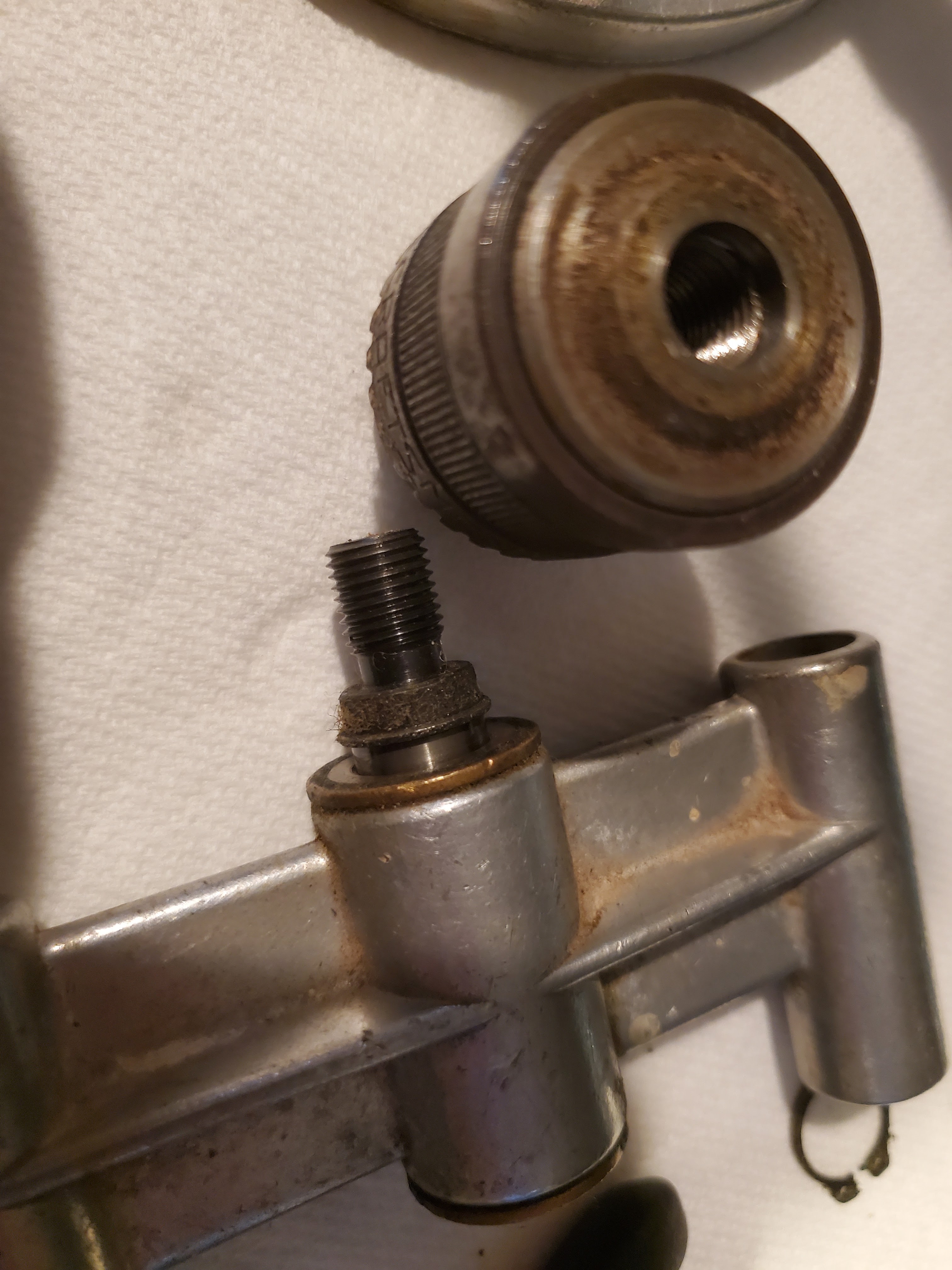
Next up was to identify the spindle that the chuck sits on.  It's a 3/8-24 thread, but I'm missing part, and also the chuck is a 3/8" chuck.  I needed to be able to handle a 3/4" diameter reamer, so a new chuck was in order, and none of those have a 3/8-24" thread mount.  That means I need to make a new spindle, with a JT3 mount on the end for the 3/4" chuck.

I pulled the spindle out.  Two clips hold that spindle in place :


I found a 9mm socket fit perfectly on the end to drive that spindle out.  I got my measurements :

(Not written down is the JT3 taper end, which is 1.2188" long, and the two ends are 0.7461" and 0.8110", or a taper-per-foot of 0.639", and an angle off of center of 1.5251 degrees.)

I chucked the new drill attachment into the lathe (1/2" straight shank, with a JT33 end for a 3/4" drill chuck), and cut a groove down to 0.467" (inside diameter for the new e-clip).  Next the shaft went into the freezer, and the chuck went onto a heater vent to get a good temperature differential for assembly.


So, I have a fully functional Craftsman Port-A-Lign with two interchangeable chucks, the original chuck, and a 3/4" banger for use in first drilling, then reaming a hole.  It's only to test reamer sizes, remember?  Sheesh, my memory has really taken a hit with this chemo thing.


Saturday, March 23, 2024

I Have a Ream

 Everybody knows that drills put holes in things.  Most people assume they are perfect holes - but some people who need accuracy know that is not the case.  So, what kinds of holes, and what to expect?  My brief, inexpertise scale from worst to best :

  • Hand drill - if you need a quick hole and don't care about vertical, size, or anything else, do this.  Even with "drill guide" blocks, you're likely to not get it vertical.  If you are going to thread this hole for a bolt, please avoid this one.  I will throw in cheap drill presses here - though with some work, they can be a little more acceptable toward the next category.
  • Drill press - these are good for getting rid of the above "vertical" orientation issues of a hand drill.  For this category, I'm throwing in drill presses, magnetic drill braces, and I'll even throw in the old Craftsman "Port-Align" attachments to the above hand drills.  They offer better consistency in your vertical alignment.
  • Drill in a lathe - sometimes you can throw the part into a lathe.  These give you MUCH better control over axis alignment, plus the holes become much more - dare I say it - ROUND!  Now, you thought the previous holes were round.  Sure, they were, kind of.  But now we're getting into a much better category and much more accurate concentricity.
  • Boring bars in lathes (or boring heads in mills).  These give you not just a concentric and round hole - these actually let you control the diameters of the said holes.  One drawback of these is the machining marks in the holes, as these are typically single-point-cutter tools that have radii on the cutting end, so while the holes are much more accurate, they still are on the rough side.
  • Reamers.  These are specialty tools designed to give you the best finishes possible, while giving you exactly the dimension you wanted.  The holes are round, concentric and parallel (provided you don't let them wander off course).

Now, I've started thinking through a low-profile, small, milling vise build, and I know I'm going to need better holes than I've done.  So, a "drill" isn't going to cut it, and what I really want are "reamers".  I found a hodgepodge of reamers on eBay that might cover the sizes I need, so I bought it, and classified their sizes (not all are stamped).

So, I measured these, not with actual use, but using some metrology equipment, which means these are likely +/-0.002".  For example, the 0.373 might be a 0.374, and the 0.374 might be a 0.376.  The only way for me to tell is to use each individual reamer, but I'm too tired and fatigued to drill that many holes without good test equipment that I can chuck some of these reamers into without moving drill heads, bases, or anything the like.

For now, suffice to say I have the following sizes in hand :

  • 0.155"
  • 0.183"
  • 0.187"
  • 0.189"
  • 0.218"
  • 0.219"
  • 0.246"
  • 0.280"
  • 0.308" (2x)
  • 0.309" 
  • 0.310"
  • 0.311" (5/16") (2x)
  • 0.354"
  • 0.373"
  • 0.374"
  • 0.382"
  • 0.498"
  • 0.499" (2x)
  • 0.500"
  • 0.515"
  • 0.749"
  • 0.751"
  • Morse Taper #2 (this was a bit of a surprise!)

Next up, trying to feel a bit better.  This could be a longer road to travel before I can get back to projects, but I've gotten this far.  If I can do so, perhaps I can start doing the mill vise.